CONSERVATIVE
By Mikey Pearce
The date is 6th October 2026. Putin’s war in Ukraine has progressed for around 4 and a half years now - though his pathetic attempt at seizing Ukrainian land throws into doubt the prior use of the word ‘progressed’. It has essentially stalled to somewhat of a stalemate, with Ukrainians and Russians wrestling with the frontlines back and forth at painstaking gains and losses. Whilst Putin seems incensed on pushing on with the war, there comes a time for even the most delusional of leaders to accept fate and end things that seem to have no good way out for them. And Putin really does not have a good way out of this war - he is ageing, Russian troop losses are mammoth, and the longer it goes on, the more painful the effects on Russia’s demography, economy and global standing will be. And of course the Ukrainians are in desperate need for the war to end, though their resilience, technological adaptability and determination is something the history books will never forget. So for all involved, the war needs to end, whether the actors involved accept that or not. But there are some difficulties in ending the war that some may not have considered.
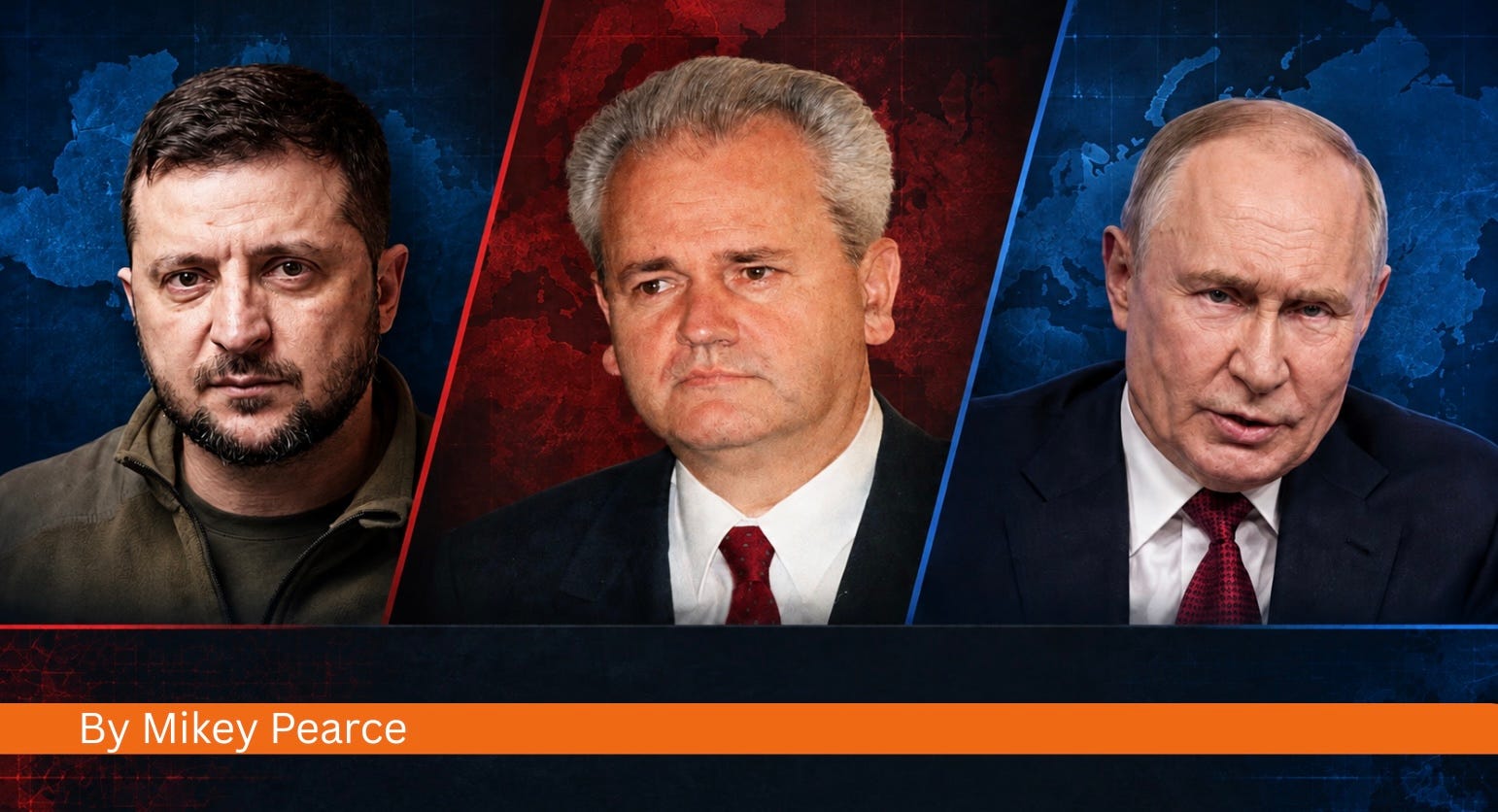
But this lesson goes back a couple of decades. Yesterday, October 5th, was the 26th anniversary of the culmination of the ‘Bulldozer Revolution’ in Yugoslavia, where dictator and Yugoslavian leader Slobodan Milosevic was eventually ousted just one day later. With this anniversary, I have done a bit of a deep dive on the Yugoslavian Wars of the 90s in recent days, and there was one thing that stood out to me greatly.
For those who don’t know the conflicts in the 1990s, Yugoslavia was a wider federation of 6 smaller republics - Bosnia, Croatia, Montenegro, Serbia, Slovenia and Macedonia. The federation eventually broke up, which started when Serbian leader Milosevic began overstretching Serbian power across the federation, which led to a horrendously messy series of conflicts, secessions and even legally recognised genocide - that of the Bosniaks.
The consequences of Milosevic’s actions became an incredibly dark stain on the history of Europe - the effects of which still live on today. When reading deeper into these conflicts, the thing that stood out to me was that the tactics used by Milosevic at the time seemed worryingly familiar. Milosevic knew that directly invading the other Yugoslavian republics when they wanted to secede from Yugoslavia would seem too much like a simple Serb conquest. So, in order to increase Serbian power in the region he took advantage of the sizeable Serb minorities in the other republics, armed them, and supported them rising up against their parent states. This allowed Milosevic to frame the hostilities as noble Serb struggles against the ‘dictatorships’ of the republics, that he, the ‘saviour of the Serbs’ came to their rescue over. They were, in fact, a creation of Milosevic’s mind designed to satisfy his goal of increasing Serb power and influence in the region. It was hostile action based on propaganda to allow a power grab.

Milosevic’s use of ethnic Serbs in other countries as a weapon is, as aforementioned, worryingly familiar to those who have been paying attention to Eastern Europe today. While Putin (apparently) aimed to conquer the entirety of Ukraine, one quick look at a map of the frontlines demonstrates that he has without doubt failed at this. He has, however, got majority control of the Donbas for the time being - the furthest east segment of Ukraine which is home to many ethnic Russians. And how did he do this? Well, it took a specific tactic back in 2014 to kick it all off. In 2014, pro-Russian separatist groups and Russian officials in the Donbas unilaterally established the new ‘Donetsk People’s Republic’ and ‘Luhansk People’s Republic’ here. Putin provided them with weapons, military equipment and political and economic support. This allowed him to initially frame the subsequent hostilities as a ‘people’s struggle’ against the ‘fascist Ukrainian state’. Fast forward to 2022, 3 days before the full-scale invasion of Ukraine, and Putin declares these new republics as independent states. He then invades Ukraine fully, citing the need to protect the people here from an apparent ‘genocide’ conducted by the Ukrainian authorities.
No such thing exists outside of Putin’s demented mind.
This leads Putin to later hold staged sovereignty referendums in the Donbas, which surprisingly overwhelming vote to become Russian. Who would have thought! So as we now can see from 2014 onwards, Putin has used highly similar tactics to seize the Donbas to Milosevic in the 1990s to seize territory across Yugoslavia. By using ethnicity as a weapon, pulling the strings to exacerbate the issue, and then waltzing into that territory as the self-proclaimed saviours.
Now let’s move into the present day, and the need to end the war in Ukraine. US President Donald Trump has bragged in the past over his capability to ‘end the war in 24 hours’. Last year, Reuters made it clear that this thinking was at least in part because of his willingness to recognise Russia’s annexation of Crimea. He was willing to give Russia Ukrainian territory. If he was willing to do this, it wouldn’t be a stretch to think that he may have considered recognising Russia’s annexation of the Donbas too. May this have stopped the fighting? Who knows. Maybe.
But it falls into a very dangerous trap. It rewards the initial action of Putin annexing the Donbas. And in 1995, Milosevic was also rewarded for his tactics in a similar manner.
The Bosnian War was ended by the Dayton Peace Agreement, which handed around half of Bosnia to a new pro-Serbian state, Republika Srpska. This state was greatly dependent on Serbia for military, political and economic reasons, and so in essence, Milosevic was somewhat rewarded for his ‘pulling of the strings’ in Yugoslavia.
Ending the war in Ukraine will not be easy. The way I see it, there are only 3 realistic options. The first is the Trump approach - recognise the territory that Russia has taken as Russian and give them what they want, hoping they stop there. The second, is a freezing of
the frontlines and a subsequent ceasefire, similar to how the Korean War was paused in the 1950s (it never formally ended). The third, is what the West have done up until this point, and continue to fund Ukraine militarily in the hope that it can defeat Russia face-to-face, or at least hold out long enough to make the war costly enough for Putin to back down.
Whatever the future holds for the war in Ukraine, there is one important factor that we absolutely cannot let happen - we must, under no circumstances, reward Putin for his tactics in the Donbas, like how Milosevic was rewarded for similar tactics in Yugoslavia.
If we do, we risk a major steepening of the uphill battle that democracy has against autocracy in the future. Because if we do, we allow history to repeat itself once again, where ‘actors change, but tactics don’t.’
Who wrote this?