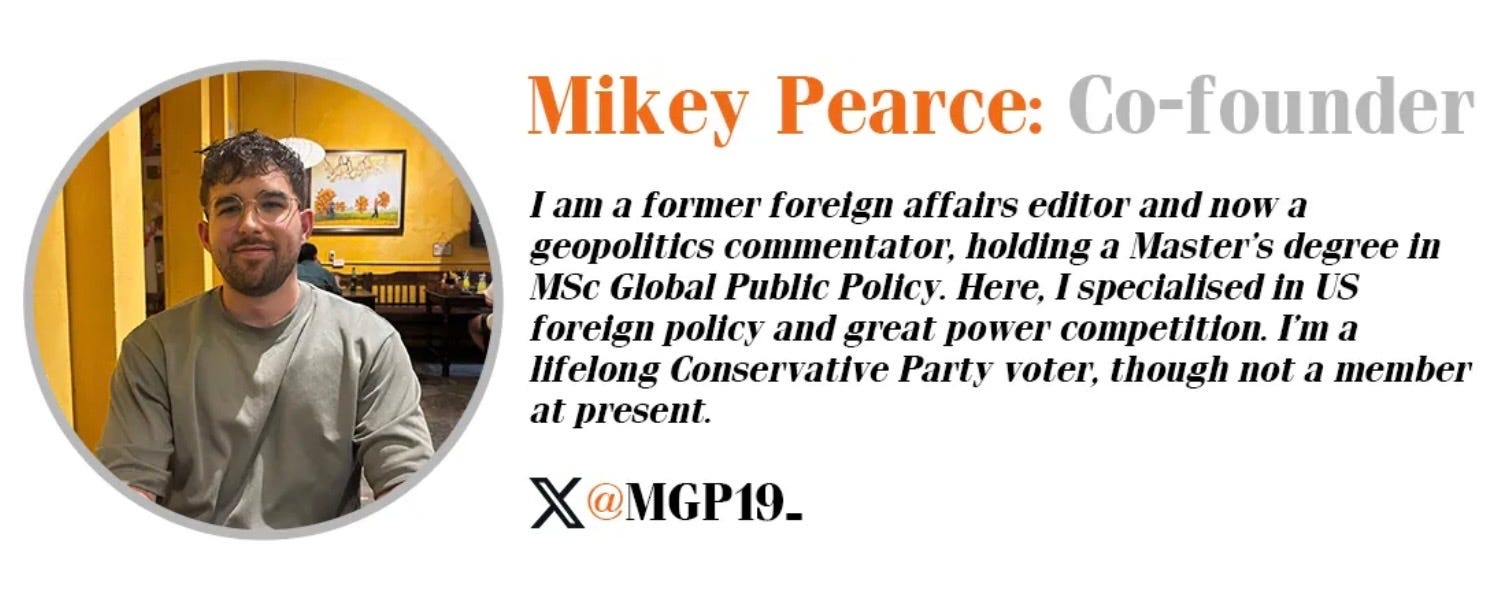
By Mikey Pearce
CONSERVATIVE

As our friends across the pond often like to remind us Brits, the 1770s were characterised by one major defining event in global politics. Political struggle turned violent. Blood between brothers was spilled en masse. As a result, Governor’s Councils eventually made way for Senates, while Kings made way for Presidents. And eventually, the Thirteen Colonies evolved into the United States of America.
The significance of this event however, was that this new country was to be different from those that came before it. In an era of absolute monarchy and of those who had more oppressing the poor, this new nation would be governed for the people, by the people. It would uphold individual rights and give the power to the citizens themselves. This was in direct response to what the colonists saw as an overwhelming tyranny handed down by King George III. It was his tyranny that led 25,000 would-be-future-Americans to their deaths for the cause - which almost all Americans today would agree was an acceptable cost for their freedom and for what they have today.
But the truth is that this ‘tyranny’ was far from tyranny in the conventional sense. The extent of the King’s ‘tyranny’ was merely the attempt to raise revenue for the British government via taxing the colonists across the Atlantic, having spent masses of money protecting the Thirteen Colonies from the French during the Seven Years’ War. The problem for the colonists was that this was ‘taxation without representation’ - representation for their political issues was nowhere to be seen over in Britain.
Fast forward to present day Britain. Us Brits have political representation. We have a real voice that the Americans did not. So why then, when those in government push terrible policy that is far more tyrannical than that of King George III’s pursuits in the Thirteen Colonies, do we not use it? I believe there is a lesson from our cousins in America that desperately needs learning in this country.
There have been several events of great concern in recent years at the very top of the British government. With the previous government, we saw Keir Starmer and David Lammy attempt to remove the ancient right to trial by jury - one of the most paramount democratic rights you can possibly give to your people, and one that has stood since 1215 with the introduction of the Magna Carta. There were many outraged critics. 3200 lawyers, including 300 King’s Counsel and 22 retired Crown Court judges, signed a Bar Council-organised letter urging the government to scrap the plans. The government pressed on anyway.
That same government tried to remove privacy protections for Britons too, as highlighted by the Apple case. Without going into too much detail, the government essentially pushed Apple to give them a backdoor option to access the personal data of British citizens who use Apple smartphones. This is not given to any other government in the world, as it is a major break from conventional data privacy rights. Apple refused, and took the government to court over it. The Trump Administration also applied heavy diplomatic pressure on Britain to force their hand and drop the move. Today, the government are still pursuing this, with legal cases ongoing behind the scenes. The worrying part however, is the government’s attempt to keep the case secret, which a UK court eventually refused due to ‘principles of open justice’.
Lastly, and perhaps the most historically reflective, is that Brits are currently being crippled under the highest tax burden since 1948. In 1948, at least we were rebuilding a country after the greatest war in the history of human existence. And today? For the privilege, we get failing public services, a failed economy with a near non-existent job market and 21% of the population declared as ‘economically inactive’. Better yet, we still have talk of a wealth tax, a licence fee to watch Netflix, and increases in capital gains tax. It is not with jest that I scream from the rooftops over just how badly the government have taken Brits for a ride in recent years.
They have developed a complacency, or perhaps an arrogance, that has led them to forget that ultimately their duty is to us as a people. Or is it?
In bringing the temperature down slightly, I am not advocating for a revolution, a war, or any form of violence over this. I do however think that Brits need greater protection from our own government. This can be done in two ways: via legal protections and via cultural understandings. Both of these are inspired by the United States.
On legal protections, the US have the Bill of Rights - the name given to the first 10 Amendments to the US Constitution. The UK too has a bill of rights, and also an unofficial constitution, but one that is uncodified and spread across many statutes and acts. The difference between the US and the UK on their constitutional setups is that the Constitution in the US is entrenched, i.e, Congress cannot pass a law that overrides the First Amendment (freedom of speech/expression). If they did, the courts would strike it down, and the new law is as good as finished. In Britain, parliament is sovereign, meaning it can override or change any law by passing an act. In other words, in America the people are the supreme authority, and their core rights are not infringed upon. In Britain, the supreme authority is the government itself. If we were more similar to the Americans constitutionally, and the government was answerable to a written constitution, we may be much safer from their ever-more overreaching hand. Diving deeper on the US Constitution, its Sixth and Seventh Amendments enshrine the right to a public trial by an impartial jury - would Starmer and Lammy’s shocking plan to remove jury trials have had any legs if Britain had had these enshrined legal protections for its people? The answer is no - it would never have even got off the ground.
Aside from the legal argument, we can also learn from the Americans on some of their cultural understandings. Due to the political environment in their revolutionary heyday, there is an in-built skepticism of government and all forms of centralised power. It serves as great embedded protection for the people, alongside the legal ones, as it is the starting gate from which all political, constitutional and legal proceedings begin from. The great benefit of this is that Americans consider by default where a legal or political change could potentially go in the worst case scenario before it ever gets there. It requires the government to meet an almighty burden of proof before changing any laws - a proof that said change would be beneficial to the people, and will not infringe upon their inalienable rights. The government are therefore undoubtedly answerable to its people from day one in America. Britain unfortunately starts from the opposite end where what Parliament says goes, which is probably the reason why the government seem to have developed the aforementioned complacency and arrogance. We must reverse this trend, and follow in the footsteps of the Americans both legally and culturally.
To repeat an earlier stated line from this essay, I truly believe it fair to say that our government has come closer to the definition of
tyranny in recent years than King George III did in the Thirteen Colonies in the 1700s. And we have largely stayed silent, endowing the government with an undeserved level of trust. Though when some do speak out, it is largely ignored. It is on us as a people to push for the legal and constitutional changes, as well as the cultural understandings, that Americans have in order to work towards a better system of government.

I want to end this essay with a note on the genius of the American Founding Fathers. The 10th Amendment to the US Constitution, the final article in the Bill of Rights, claims that:
“The powers not delegated to the United States by the Constitution, nor prohibited by it to the states, are reserved to the states respectively, or to the people.”
In plainer terms, it suggests that if the Constitution does not give an explicit power to the government, then it is purely a matter for the people to decide. It is NOT the place of the government to create that power for themselves. In fact, the document prohibits them from doing so. How amazingly unbelievable that nearly 300 years ago, these young, often 20-something year old men had the political awareness to write this clause in, giving near endless protection to the people through just 28 written words on a piece of parchment? Do the government still try to circumvent these protections? Of course. But the threshold for intervening in a citizen’s private affairs is far higher than in the rest of the world.
Now it would be misleading to claim that the early United States protected its citizens better than Britain today in any universal sense of course - at this point in time, slaves were considered property instead of citizens, and women lacked equal rights. Yet, for those within its protection, the US Constitution established a special constitutional guarantee - the rights of the people were placed beyond the authority of the government. They were and are untouchable. Inalienable. Britain, in contrast, leaves these rights vulnerable to a hopefully sensible steward in government.
And that is an oversight that has left Britons sailing in waters that they hope remain forever tranquil. The Americans on the other hand, simply never need to sail in the rain.
Who wrote this?